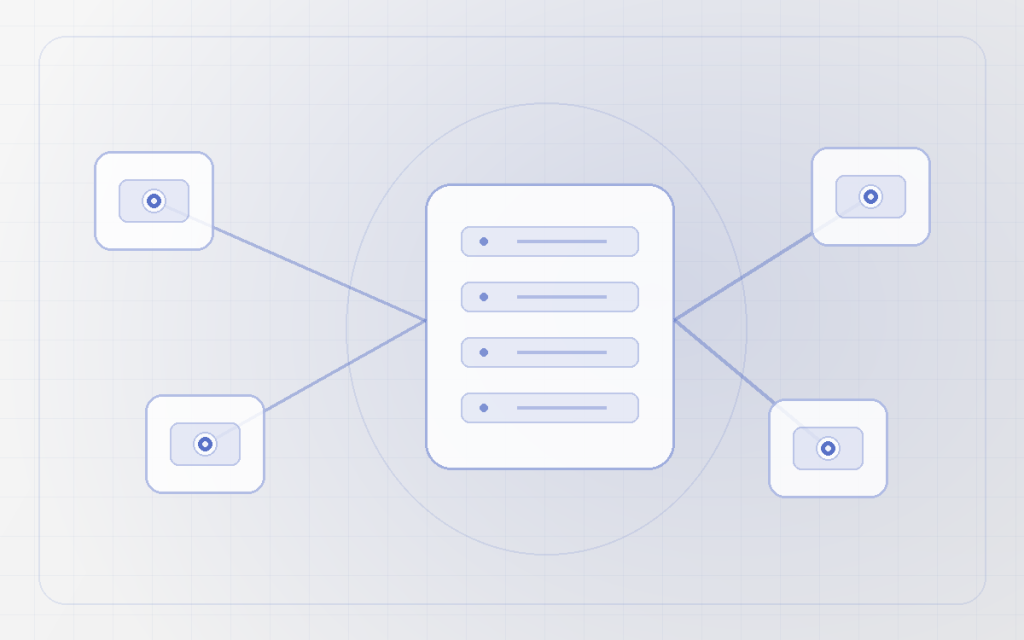
Edge computing places selected processing closer to where data is created or used. Centralized processing concentrates work in a smaller number of regions or facilities. Neither arrangement is automatically faster, safer or simpler. The right architecture depends on the shape of the work, how much state must be shared, operational capability and the consequences of failure.
Architecture and data flow
In a centralized design, clients send requests to a main application region. The region can keep databases and services close together, simplifying transactions and deployment. In an edge design, an initial layer near the user may cache content, validate requests, transform data or run a limited function. Some requests still travel to a central system for durable storage or coordinated decisions.
The boundary between edge and center is therefore more important than the label. Identify what can be handled with local information and what needs authoritative state. A static image is easy to cache. A bank-like balance or inventory reservation needs stronger coordination and cannot simply be copied to every location without rules for conflicting updates.
Performance and latency
Moving suitable work closer to users can remove a long round trip. This often helps content delivery, lightweight personalization and immediate filtering of sensor data. But an edge function that calls a central database for every request may add an extra hop without removing the original dependency. Measure the complete user task, not only time to the first edge endpoint.
Centralized processing can be fast when users are concentrated near a region, data dependencies are colocated and caching is effective. It can also simplify optimization because the critical path has fewer distributed boundaries. Performance should be assessed using realistic traffic, data size and connection conditions.
Scalability and operations
Edge distribution can absorb requests across many locations and reduce origin traffic for cacheable work. It also multiplies places where code, configuration and observability need to remain consistent. Rolling out a change gradually becomes important. Operators need to know which version ran in which location when a problem occurs.
A central region can be easier to manage and debug, though capacity planning must handle concentrated demand. Scaling either design involves more than adding servers. Shared databases, queues, rate limits and external APIs can remain bottlenecks. Map these dependencies before assuming that wider geographic deployment will solve load.
Reliability and failure modes
Edge services can continue to serve cached or limited responses when an origin is unreachable. That resilience depends on the application accepting stale data or reduced functionality. A central design may have simpler consistency but greater exposure to a regional outage unless it has a tested recovery plan.
Distributed systems face partial failures: one edge location may fail while others work, a replication link may lag, or a client may switch regions during a session. Define expected behavior in each case. Failure tests should cover stale caches, retries, duplicate requests and recovery, not only a total service outage.
Security and privacy
Processing near users may allow raw data to be filtered before transfer, which can support data minimization. It also expands the number of execution locations and configuration surfaces. Access controls, secret handling, software updates and logging policy must apply consistently. Some data may need to remain in a specific jurisdiction or approved environment.
Centralized processing offers a smaller set of places to protect, but transporting all data centrally may create additional exposure or policy concerns. Evaluate the full path: collection, transit, storage, retention and deletion. A design is secure because of its controls, not because of its geography alone.
Common use cases and trade-offs
Edge processing is useful for caching public assets, filtering high-volume device events, reducing response time for local interactions and enforcing certain request policies. Central processing remains attractive for complex transactions, model training, shared analytics and operations that require a single authoritative state. Many practical systems use both: fast, bounded work at the edge and durable coordination in a central service.
Choose the split by listing user actions and their dependencies. Estimate which delay is removable, what data consistency is required, what happens when a region is unavailable and what the team can operate reliably. Prototype the most important path and compare it with a simpler centralized baseline. Complexity is justified only when it produces a measured benefit or meets a concrete resilience, privacy or compliance need.
A migration does not have to be all at once. Start with a bounded function such as static asset caching or request validation, then observe the effect on the whole workflow. Keep a fallback path to the central service and document how data and configuration versions are synchronized. If the edge layer cannot safely operate during an origin outage, make that limitation explicit. The best architecture is often hybrid, with each layer doing the work it can own clearly and with enough evidence to justify its operational cost.


